.jpg)
Weekly Newsletter
Freedom Calls: 2/3/26: The US has spoken….
by
The team at Freedom Asset Management
March 2, 2026
12 Minutes

Freedom Calls: 2/3/26: "The US has spoken…."
From the team at Freedom Asset Management
Writing this from Tokyo…. first up, our thoughts are very much with the team, our clients and friends of the firm who are living across the UAE and the Middle East more broadly. May this be over quickly. And hats-off to the UAE defence ministry who announced that of the 137 ballistic missiles that were launched from Iran to the UAE on Saturday, 132 were intercepted (see below a puff of white smoke in the sky, with one of those missiles being taken out):

Picture credit: Freedom's Charles Harris view from the beach in Abu Dhabi, 28/2/26
So let's talk about how we think this could play out. I think there are two main scenrios:
It's all over quite quickly (i.e. possibly this week)
I was in London at the beginning of last week, before the action, and caught up with one of my sources close to the Americans. It was suggested that early last week, the Iranians were being offered the "Maduro deal" i.e. Khamenei given an exit package to Russia. He declined, but at 86 years old, he probably had a different perspective on life.
The point being that the people who hold the real power in Iran are the army - and a deal with the army leaders (like in Venezuela) could bring change without significant further bloodshed - and still provide some institutional structure to allow some kind of future governance (possibly a form of democracy) to prevail. Now that Khamenei is no longer in the room, and before his successor is anointed, there is a scenario that the generals are up to negotiate - and take a deal whilst they still can.
So our base case is that this war could be over by next weekend. And that makes some sense. Trump had said there are another 2-3 days of bombings planned (…. albeit as of this morning, he now says it is 4 weeks, but that is probably a negotiating ploy). The mission is to take out all the missile sites and production facilities; it is also to prevent any ability to rebuild the nuclear facilities. The American and Israeli use of force has been dramatic, decisive and swift - they do not need 4 weeks to do this.
I am sure there is zero appetite for putting American soldiers on the ground, but the American and Israeli ability to bomb Iran into submission is unmatched.
There does not appear to be a formal "Day 2" plan from the Americans, so they are relying on the people of Iran to rise up and "take their country back". It would be much easier, (if not so elegant), to do that with the military onside.
The generals do not deal
There is also the scenario that the Iranian generals dig in for a while. If that happens, we know from previous research that wars typically take less than 90 days, or longer than 3+ years - and usually it is the former. The Falklands War, by way of example, was over in 74 days, even if in my memory it seemed to take much longer.
As we said in a previous newsletter, this conflict is not the same as Venezuela, because this is not one corrupt official being lifted out and replaced by someone less corrupt, and more compliant. This is, at least partly, about religion. This makes it potentially more complicated.
If the generals do not deal, the Americans and Israelis could dramatically dial up the pressure, but by that point it will likely need the Americans to drive the future leadership outcome in Iran. This could be quite protracted.
So I suspect that a lot will be decided by the actions taken this week.
Performance
The table below is as of close of markets Friday last week:
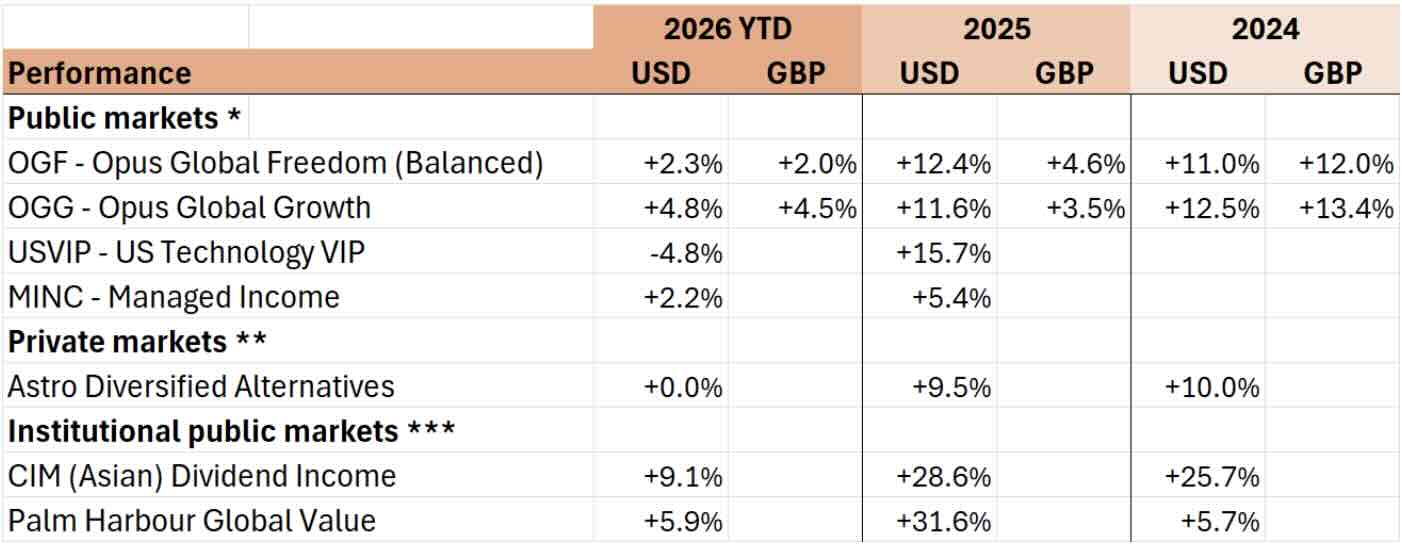
(See performance disclaimer at foot of email)
We are pleased with the performance of OGF, OGG and especially our lowest risk fund MINC.
Cody and the team at USVIP have done a great job of negotiating a way through the software collapse that has seen Microsoft down 19% this year so far, and Salesforce down 27% over the same period. Cody writes a great piece as to why the market is wrong about AI and why this is a great entry point. USVIP investors will remember that last year we also saw some wild rides, but everybody that invested during those rides was very happy by the end of the year. This year will doubtless be the same.
Thank you for all of you who have invested or topped up in the last few weeks.
Investors may remember that 10 days ago we took down risk significantly in OGF because we were concerned that an American attack on Iran was imminent. In OGF, also our new commodities fund purchase was up 2.8% on the week.
As I write this Monday morning, the S&P futures are looking down c.1% and the oil price is up c.7%, but that can change a lot before US markets open and the rest of this week. We remain vigilant on the markets in the short term, but remember that when this conflict is over, the world will be a safer place - and that will be good for markets.
Our articles this week:
Cody Willard of 10,000 Days reminds us that "The AI Revolution will be the single most impactful revolution that humanity will ever live through"
Justin Oliver of Canaccord talks to us about "The elusive search for a US recession"
Charles Harris from our Abu Dhabi Investment Team writes about "What we know about the US-Israeli strikes and Iranian retaliation"
This weekend my plan was to write to about my Japan research trip, but as is so often the case, life has a different plan. But don't worry, I am saving up the Japan piece - so hopefully next week. This week I am based in Hong Kong.
Freedom's operations remain unaffected by the conflict in the Middle East - the Abu Dhabi team will be working from home and supported by our colleagues in Guernsey and Hong Kong. Please do not hesitate to reach out if you need any assistance.
We are very much hoping for a swift end to the conflict. Wherever you are, perhaps more than ever, please make sure this week is a safe one.
All the best,
Adrian
Co-Founder // Freedom Asset Management
Guernsey // Abu Dhabi // Hong Kong
M: +44 7781 40 1111 // M: +971 585 050 111 // M: +852 5205 5855
————————————
“The AI Revolution will be the single most impactful revolution that humanity will ever live through", 2/3/26
By 10,000 Days' Cody Willard and Bryce Smith - Advisers to US Technology VIP Fund

Let me be clear at the outset here. Yes, The AI Revolution will be one of the, and perhaps the single, most impactful Revolutions that humanity will ever live through (The Robotics and Space Revolutions will be up there too, of course!).
But it's not going to send society into some dystopian nightmare of a future. And it's not going to end work as we know it or kill every job in the economy. It's going to create tens of trillions of dollars of wealth in coming decades. Here's why.
Last week, some random, basically unknown research firm, called Citrini, published a random dystopian AI paper that somehow went viral and shook the stock market. Which wasn't terribly surprising because for the last few weeks, the markets had, at various moments tanked bank stocks and software stocks and broker stocks and other sectors of the economy. And to be clear, some of this fear, uncertainty and doubt makes sense, as The AI Revolution will certainly impact each of those sectors (and each company in each of those sectors) in meaningful ways. As the market has started recognizing that coming impact, it's introduced more uncertainty around the fundamental outlooks, which obviously brings lower price multiples.
On the other hand, this dystopian nightmare of research – yes, the research itself is a nightmare, not just the future it outlined – reads like the authors were going for maximum dystopian scenarios. I too can think though a worst-case scenario of how everything could go wrong in the world, in tech, in society, with jobs and wars and so on. But just because we can think of those scary scenarios doesn't mean that they are likely or even really possible.
I have been saying for years now and I will repeat it again today: The AI Revolution and The Robotics Revolution will CREATE more jobs than they destroy. They will enable everybody who works to do MORE work for MORE people MORE affordably. I have no idea why everybody is so sure that when they look around at society and the economy today that we are almost at PEAK EVERYTHING. Like, there are always more homes to be built, there are always more floors to be laid, there are always more people who need access to health care, there are always more people who could use affordable attorneys, accountants, tax programs, etc. etc. etc. There are NOT ENOUGH people to fill all the jobs that are coming down the pike enabled by The AI and Robotics Revolutions.
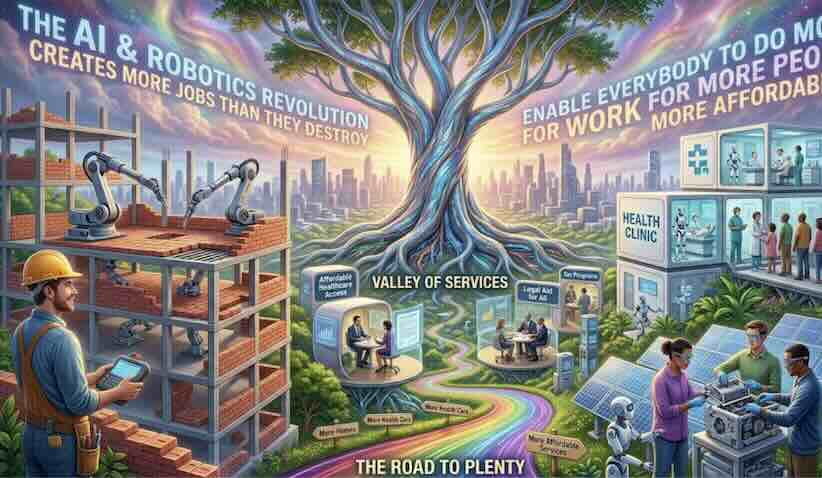
When I was giving a talk in Abu Dhabi a few weeks ago to a room full of sophisticated investors, I mentioned that we'll soon be seeing robots tying rebar and hanging sheet rock and otherwise doing what was heretofore known as "manual labor", but in future generations will be called "mostly robotic labor." But robots won't be taking every manual labor job because there's so much more work to be done, so many more ditches to be dug, so many more high-rises to be built ever faster. After my talk was over, a sharply dressed man, approached me and told me that he runs a real estate development and high-rise construction firm in the UAE. He said they actually already have robots on site tying rebar and hanging sheet rock. I said, "Have you laid any construction workers off as a result of the robots doing work?" He laughed and said, "No, it's just like you talked about in your speech: The robots are helping us get the buildings built faster so we can build more in the future."
A few days later, I finished giving a similar talk to a room of financial advisors and analysts in Guernsey, and afterward a young man approached me and said, "We are using robots, which keep getting more advanced all the time, to milk our Guernsey cows and otherwise help us run our diary." If you've ever had Guernsey butter, you know how serious they take their butter and why. Anyway, I asked him if he'd laid off any of his dairy workers as a result of the robots helping, and he laughed and was like, "No, it just frees up a little more time for me and my family every morning, night and on weekends. We still have more work to do than we can ever get done. And we are trying to figure out how to grow our business, which is where the robot help really, well, helps."
These two little anecdotes underscore why the fear of mass unemployment is so misplaced. Similarly, in offices, accountants and attorneys and writers and software developers and so on will likewise be able to use AI to do more work for more customers more affordably with higher profit margins and, yes, to grow their businesses and prosperity. The whole point of The AI and Robotics Revolutions is to make work easier, faster and more productive. There's always more work to do and making work easier is a good thing, not a detriment to society or the economy or to jobs themselves.
I expect there's a lot of you reading this that think I'm crazy because these views I'm expressing here are so antithetical to what every other analyst and economy are saying about The AI and Robotics Revolutions and their potential impact on employment, society and the economy. And I'm comfortable with that. It's often the most ironic, the most surprising, the least expected outcome that usually happens. Who knows why. Maybe I'll ask AI to explain it to me.
What's really exciting for me as a fund manager is that the market is so disconnected from this very realistic and most probable future. We're getting to buy some of the most Revolutionary companies driving these AI and Robotics Revolutions forward at very reasonable, even very cheap, levels, setting up our portfolio for some very likely outsized gains in the years ahead.
I'll continue to bet that The AI and Robotics Revolutions (just like every other Tech Revolution in history including The Electricity, PC, Internet, Cloud, Smartphone, etc Revolutions) will continue to create more economic growth (they certainly have so far!), more prosperity (check!), more applications and services (oh yea!), more entertainment (coming soon!), more affordability (happening already!), more entrepreneurship (democratizing apps, software, entertainment, etc is already doing this!), and more good stuff in general.
The future of society and the economy isn't utopian or dystopian. But it will be incredibly profitable and prosperous for those of us who position ourselves properly now.
Cody Willard
——————————————
"The elusive search for a US recession", 2/3/26By Canaccord’s Justin Oliver – Adviser to the Opus Global Growth Fund

The last significant recession in the US lasted 18 months, from its December 2007 peak to its June 2009 trough. This so-called ‘Great Recession’ was triggered by the subprime mortgage crisis and the subsequent global financial collapse. It was the longest and deepest downturn since the Great Depression. By contrast, the Covid-19 recession lasted just two months, from its February 2020 peak to its April 2020 trough. This was the shortest recession in US history, caused by the sudden government-imposed economic shutdown during the onset of the pandemic.
Since then, the economy has experienced the most widely anticipated recessions that never happened.
These fears were triggered by the pandemic, social distancing requirements, supply-chain disruptions, soaring inflation, Russia’s invasion of Ukraine, the tightening of monetary policy, a mini-banking crisis, tougher immigration and deportation policies, Trump’s tariffs, a federal government shutdown, and a challenging labour market for job seekers - all challenges with the potential to have clobbered a less resilient economy.
The newest concern triggering recession fears is that real personal disposable income has been flat for several months. Consumer spending growth has been bolstered by a falling saving rate, and the harbingers of gloom are warning that this isn’t sustainable, implying that consumers will be forced to retrench, sending the economy into a recession.
While the economy’s naysayers are unlikely to remain quiet for long, they needn’t get alarmed by the flattening of real disposable income. Instead, it’s the increasing retirement of Baby Boomers, who were well paid before they retired, that’s depressing disposable income and saving. Once retired and no longer earning taxable wages and salaries, people rely on their retirement nest eggs and on the income they earn from their investments. So they continue to spend even though their earned income has dropped to zero. They have little need to save and that results in a falling saving rate. It should also be noted that the labour market is starting to show more signs of life.
During January, payroll and household employment rose 130,000 and 528,000, respectively. This relatively strong performance was foreshadowed by declining weekly initial and continuing unemployment claims, which remain low, suggesting that February’s employment report might also be surprisingly strong. The unemployment rate fell back down to 4.3% last month and probably remained this low in February.
In addition to ringing the alarm bell over the sustainability of consumer spending, the alarmists are warning about signs of distress in the private debt market. The prices of ETFs that invest in private debt have been falling for the past year. That is certainly a legitimate concern: a freeze-up of the private debt market could cause a credit crunch for borrowers in this market. However, we aren’t convinced that risk to the financial system broadly is increasing. That’s because if the private debt market were to freeze up, the Fed no doubt would swiftly provide an emergency credit facility to avert an economy-wide credit crunch. The Fed has had extensive experience doing so during the Great Financial Crisis, the Great Virus Crisis, and the Mini-Banking Crisis of March 2023.
While recession fears remain a perennial feature of the economic landscape, the evidence continues to point toward resilience rather than retrenchment. The US economy has already weathered a remarkable series of shocks, from pandemic disruption and geopolitical conflict to aggressive monetary tightening and financial-sector tremors, without tipping into contraction. Labour market strength, still-solid household spending, and the structural dynamics of demographic change suggest that current concerns may be overstated.
Flattening disposable income reflects retirement transitions more than consumer strain, and while pockets of stress in private credit warrant monitoring, systemic risk appears contained, particularly given the Federal Reserve’s demonstrated willingness and ability to intervene if necessary. In short, the much-anticipated recession remains elusive. Until labour markets deteriorate materially or financial conditions tighten decisively, the US expansion, though slower and more uneven, appears intact rather than imperilled.
Justin Oliver
—————————————————————
"What we know about the US-Israeli strikes and Iranian retaliation", 2/3/26
By Charles Harris - Investment Team

On the morning of February 28th, the US and Israel launched a joint operation with the sole intent of ‘eliminating imminent threats’ to the American people; as noted by DJT in a video posted on Truth Social on Saturday, noon (UAE). In the 8-minute video, DJT mentions the following:
The 1979 US embassy seizure in Tehran in which 52 US hostages were held for 444 days – 8 Americans died in the failed rescue operation
The 1983 bombing of US and French military barracks in Beirut – 307 dead (241 American)
The 2000 bombing of USS Cole – 17 Americans dead
The killing and maiming of hundreds of US servicemen in Iraq
The countless attacks from Iranian proxies in the region
The funding of terrorist organisations in the Middle East and further abroad
And finally, the October 7th attacks in Israel – which included 46 dead Americans
It’s fair to say that the US has never forgiven or forgotten the humiliation endured under Iran's Supreme leaders Khomeini (1979-1989) and Khamenei (1989-2026).
"Operation Epic Fury" as the US is calling it, or "Operation Roaring Lion" as the Israelis are, began with some 200 Israeli Air Force (IAF) jets completing a broad strike against Islamic Revolutionary Guard Corps (IRGC) aerial defence systems and missile launchers in western and central Iran. The Israelis later announced that 500+ targets were hit, in what was the largest flyover in IAF history.

US-Israeli strikes are in red and Iran counter strikes are in blue. (Source: Reuters 01/03/2026)
Israel’s combat aircraft fleet consists of F-35s, F-16s and F-15s all of which have been customized specifically for the IAF.

In the run up to this massive attack the US had moved 1/3 of its military to the region. Including two aircraft carrier groups (see below).

The US used an array of weapons for their role in the strike:
Tomahawk Cruise Missiles
Fighter jets (F-18s and F-35s),
Low-Cost Unmanned Combat Attack Systems (LUCAS), and
B-2 Bombers.
Tomahawk Cruise Missiles – these 1.5 tonne missiles use GPS to accurately hit targets up to 1,600kms away and can be launched from land or sea. These cost the American taxpayer approx. $1.3m each, according to the Pentagon 2026 budget.
F-18s and F-35s - As mentioned above F-35s with the IAF jets, the F-35s are fifth generation stealth fighter capably of evading radar detection. F-18s on the other hand, similarly to the F-16s, are multi-role combat aircraft that can conduct both air-to-air and air-to-ground raids.
LUCAS – CENTCOM announced the use of the LUCAS drone – the first use of the US’s new autonomous loitering munition – targeting the IRGC. The LUCAS drone, developed by SpektreWorks (US based firm), is a reverse engineered version of the Iranian Shahed-136. This particular model, the LM 136 has a 500-mile (804km) radius and a 40lb. (18kg) payload. Per unit these cost the American taxpayer $35k.
Northrop B-2 Spirit - the Pentagon announced last night that four B-2 stealth bombers were flown non-stop from the US (refuelling en route), with 2,000lb. bombs (907kg) to strike the Iranian ballistic missile fields. The B-2 is the US’s most expensive piece of machinery - approx. $2.2bn per unit.
Israeli news sites reported that more than 40 senior Iranian officials – including the Supreme Leader of Iran Ali Khamenei himself – were killed in the initial strikes, carried out in under one minute. Khamenei’s daughter, son-in-law and grandson were killed in the strike along with the following officials:
- Ali Shamkhani (Secretary of Iran’s Defence Council),
- Abdolrahim Mousavi (Chief of Staff to Armed Forces),
- Aziz Nasirzadeh (Minister of Defence)
- and Mohammad Pakpour (Commander in Chief of IRGC)
As of last night the US and Israel have reportedly bombed 1,000+ targets in Iran.
How did Iran retaliate?
Iran’s retaliation - “Operation Truthful Promise 4” - was rapid and indiscriminate. These are some of the reported figures regarding projectiles fired by Iran:
- UAE: 165 ballistic missiles, two cruise missiles and 541 drones
- Bahrain: 45 ballistic missiles and 9 drones
- Qatar: 65 ballistic missiles and 12 drones
- Kuwait: 97 ballistic missiles and 283 drones
Israel, Saudi, Jordan and Oman were also targeted.
Iran’s arsenal for the attacks:
HESA Shahed 136 – Iran’s loitering munition of choice and the one reverse engineered by the US. The Shahed has a range of 2,000km and can cost as little as $20k per unit. The Shahed 136 was identified as the projectile that damaged the Fairmont Hotel in Dubai on Saturday evening. This weapons key strength is its ability to be mass produced at low cost.
Standard Ballistic Missiles - Standard ballistic missiles were used to target the Al Udeid Air Base in Qatar and the Al Dhafra Air Base in Abu Dhabi. While most of these are intercepted easily by THAAD and Patriot batteries, some falling debris caused damage and fires started in some locations.
Fattah 2 - Reports indicate Iran used the Fattah-2 for the first time in combat against U.S. forces in the region. This missile features a hypersonic glide vehicle (HGV) designed to manoeuvre and approach targets from unexpected directions, making it exceptionally difficult for traditional systems like the Patriot to intercept.
We will keep you posted on further developments as each side plays out its strategy and tests its hardware.
Charles Harris
—————————————————
Disclaimers
Performance table
Capital at risk. Returns in US dollars unless otherwise stated. Source: * Estimates Freedom Asset Management as at 1/3/26. Please note depending upon how the funds are invested a small number of underlying funds can price 1-2 days after we take our estimates above so final published NAVs may vary. Estimated GBP returns are from a $1.25 FX rate on 31/12/24 and $1.34 as at 31/12/25. Please note launch dates of USVIP 12/2/25 and MINC 20/5/25. ** Note fund prices quarterly and includes 5% discount to NAV expressed as 5% performance above for 2024, note also that the 2025 estimate takes the MCAS December 2025 estimate and deducts the estimated charges of the Astro feeder fund. *** Morningstar as at 1/3/26, I shares for CIM Dividend Fund, F shares for PHC Global Value Fund.
General
If you would like to be removed from this Monday morning mail, please reply ‘unsubscribe’.
Capital at risk. For further details about any of Freedom’s investment strategies or a copy of any fund prospectus, please contact investor@freedomasset.com. Please note: The value and the income produced by strategies may fluctuate, so that an investor may get back less than initially invested. Value and income may be adversely affected by exchange rates, interest rates, or other factors. Levels and bases of taxation may change. Investors should consult their own tax advisor regarding their individual tax treatment with respect to the strategies referred to herein. This document does not represent a research report. The opinions expressed are those of the authors only, and may not be representative of, or shared by, Freedom Asset Management Limited or its affiliates. This email should not be considered to be an offering memorandum and is not an offer to sell nor a solicitation of an offer to purchase interests in any fund. Offers and sales will be made only pursuant for the current prospectus, constituent documentation and in accordance with applicable securities laws. A decision to invest in any of the funds should only be based upon review of such documents and these materials are qualified in their entirety by reference thereto.
Please note Freedom’s investment strategies are only available to Professional Investors, as determined by the relevant jurisdiction.
This message is intended solely for the addressee and may contain confidential or privileged information. If you have received this message in error, please permanently delete it and do not use, copy or disclose it. Freedom Asset Management Limited is licensed to carry on controlled investment business under the Guernsey Financial Services Commission (GFSC); Reference Number 2262946. The registered office of Freedom Asset Management Limited is: 2nd Floor, New Century House, 2 Jubilee Terrace, St Peter Port, Guernsey, GY1 1AH, Channel Islands. Freedom Asset Management (Middle East) Limited is authorised and regulated by Abu Dhabi Global Market (ADGM) Financial Services Regulatory Authority, No: 250016. The registered office address of FreedomAsset Management (Middle East) Limited is Office 2406, Tamouh Tower, Al Reem Island, Abu Dhabi Global Markets, Abu Dhabi, United Arab Emirates. Freedom Asset Management (Asia) Limited, holds a Type 9 Asset Management license from the Securities and Futures Commission in Hong Kong, Ref: BUR351. The registered office of Freedom Asset Management (Asia) Limited is Rm 97 5/Fl United Centre, 95 Queensway, Admiralty, Hong Kong.
© 2026 Freedom Asset Management Limited.